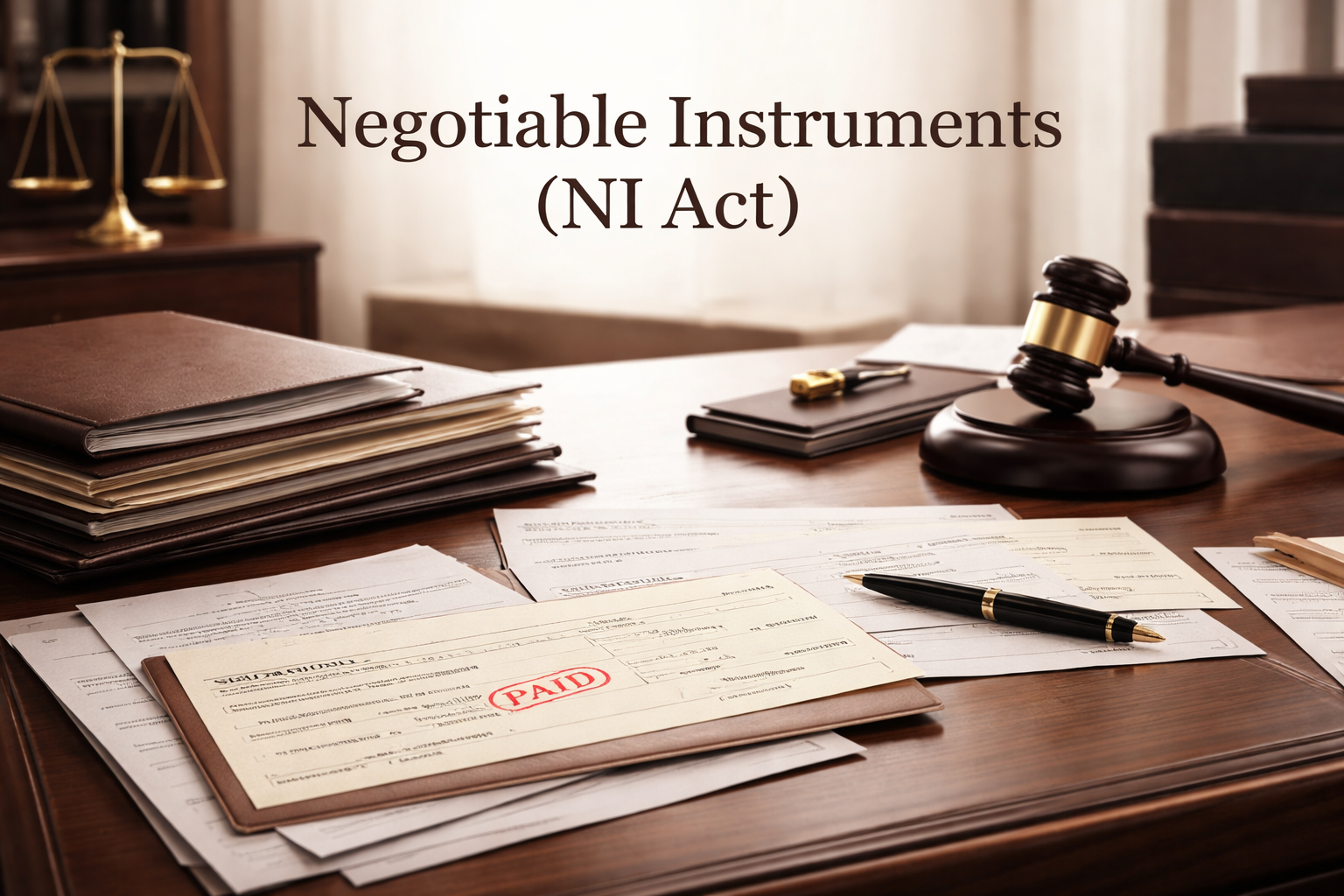
The Negotiable Instruments Act, 1881 is a crucial piece of legislation that governs financial instruments like cheques, promissory notes, and bills of exchange. It plays a vital role in facilitating smooth commercial transactions, ensuring trust in financial dealings, and providing legal remedies in case of defaults such as cheque bounce.
What are Negotiable Instruments?
Negotiable instruments are written documents guaranteeing payment of a specific amount of money, either on demand or at a future date. These instruments can be transferred from one person to another, making them an essential tool in trade and commerce.
The three primary types of negotiable instruments are:
- Cheque
A written order directing a bank to pay a specified amount from the drawer’s account to the payee. - Promissory Note
A written promise by one party to pay a certain sum to another party. - Bill of Exchange
An order from one party directing another to pay a specified amount to a third party.
Key Features of Negotiable Instruments
Negotiable instruments have certain unique characteristics:
- Transferability – Easily transferable by endorsement or delivery
- Title – Holder gets a clear title if obtained in good faith
- Negotiability – Can be passed from one person to another
- Legal Recognition – Enforceable under law
- Certainty – Fixed amount and clear terms
These features make them widely used in business transactions.
Importance of the NI Act
The Negotiable Instruments Act, 1881 ensures:
- Legal validity of financial instruments
- Smooth functioning of banking and trade
- Protection against fraud and default
- Quick remedy in case of dishonour
- Increased confidence in financial transactions
It is especially significant for businesses that rely on credit and deferred payments.
Section 138: Cheque Bounce Cases
One of the most important provisions of the NI Act is Section 138, which deals with cheque dishonour due to insufficient funds.
Conditions for Applicability:
- Cheque issued for legally enforceable debt
- Presented within validity period (3 months)
- Dishonoured due to insufficient funds
- Legal notice sent within 30 days
- Payment not made within 15 days of notice
If these conditions are met, the drawer can face criminal liability.
Punishment Under Section 138
- Imprisonment up to 2 years
- Fine up to twice the cheque amount
- Both imprisonment and fine
This provision acts as a deterrent against financial fraud.
Procedure in Cheque Bounce Cases
- Cheque Presentation
- Dishonour by Bank
- Issuance of Legal Notice
- Waiting Period of 15 Days
- Filing Complaint in Court
- Trial and Judgment
Timely compliance with each step is essential.
Role of Banks in Negotiable Instruments
Banks act as intermediaries in processing negotiable instruments. Their responsibilities include:
- Verifying signatures
- Ensuring sufficient funds
- Processing payments
- Issuing dishonour memos
Banks play a crucial role in maintaining the integrity of the system.
Holder and Holder in Due Course
- Holder – A person entitled to receive payment
- Holder in Due Course – A person who acquires the instrument for value, in good faith, without notice of defects
A holder in due course enjoys special legal protection.
Crossing of Cheques
Crossing adds security to cheques:
- General Crossing – Payment through bank only
- Special Crossing – Payment to a specific bank
- Account Payee Crossing – Payment only to the named account
Crossing reduces the risk of misuse.
Endorsement of Instruments
Endorsement means signing the instrument for transfer. Types include:
- Blank endorsement
- Special endorsement
- Restrictive endorsement
This allows easy transfer of ownership.
Digital Evolution and NI Act
With digital banking and electronic payments, the relevance of traditional negotiable instruments is evolving. However, cheques are still widely used in business and legal transactions.
Amendments have been introduced to:
- Enable electronic cheque processing
- Speed up cheque bounce cases
- Improve banking efficiency
Recent Amendments
The NI Act has been amended to strengthen its provisions:
- Interim compensation to complainant
- Faster trial procedures
- Jurisdiction clarity for filing cases
These changes aim to reduce delays and improve enforcement.
Civil vs Criminal Liability
Cheque bounce cases under Section 138 involve:
- Criminal Liability – Punishment for dishonour
- Civil Liability – Recovery of money through civil suits
Both remedies can be pursued simultaneously.
Importance for Businesses
For businesses, the NI Act is essential:
- Ensures secure transactions
- Provides legal protection against defaults
- Helps in credit-based dealings
- Builds trust in financial operations
Proper understanding helps avoid disputes and losses.
Preventive Measures
To avoid issues under the NI Act:
- Maintain sufficient funds
- Verify cheque details carefully
- Keep proper transaction records
- Use digital payment methods when possible
- Issue cheques responsibly
Prevention reduces legal complications.
Challenges in Implementation
- Delay in court proceedings
- High volume of cases
- Misuse of provisions in some instances
- Dependence on traditional payment methods
Reforms are ongoing to address these challenges.
Conclusion
The Negotiable Instruments Act, 1881 is a cornerstone of India’s financial and commercial system. It ensures reliability, legal protection, and smooth functioning of negotiable instruments like cheques and promissory notes.
With strong provisions like Section 138, the Act provides an effective remedy against cheque dishonour and financial misconduct. For individuals and businesses alike, understanding the NI Act is essential for safe and compliant financial transactions.
Leave a Reply